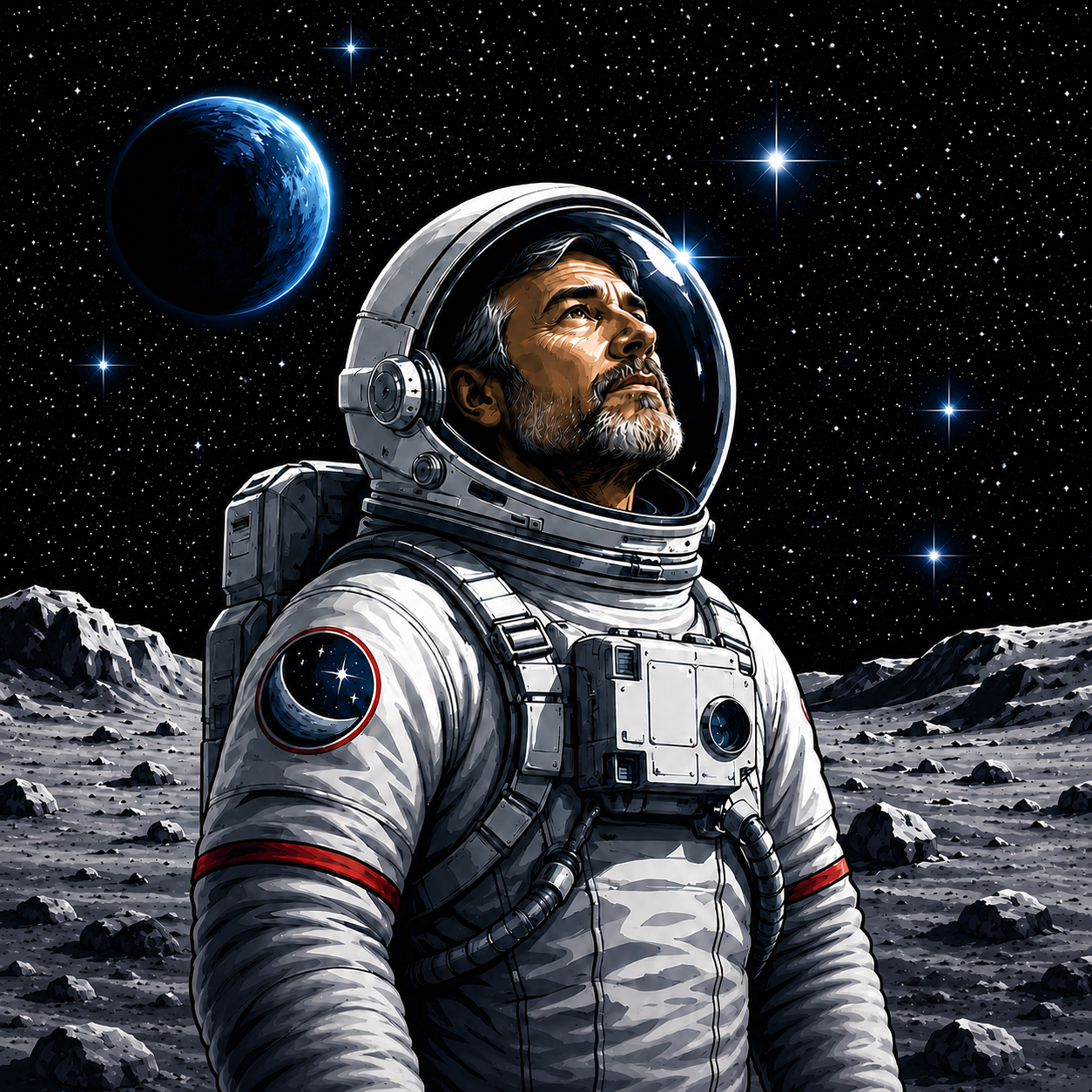
Quantum Immortality: The Dark Secret of the Multiverse
Quantum immortality claims that in Max Tegmark's branching multiverse your consciousness can never experience its own death. Here is the physics, the argument, and why it falls apart.
Imagine a machine wired to a single subatomic particle. Pull the trigger, and in half of all possible outcomes a lethal mechanism fires instantly. In the other half, nothing happens. Pull it again. And again. A thousand times. By every ordinary measure of probability, you should be dead within seconds. And yet, the argument goes, from behind your own eyes you will never experience a single one of those deaths. You will only ever find yourself among the survivors.
This is quantum immortality, the disturbing corollary of a setup called quantum suicide. It does not come from mysticism. It follows, step by step, from one of the most mathematically respected frameworks in modern physics: the Many-Worlds Interpretation of quantum mechanics, the branching multiverse formalized by the MIT cosmologist Max Tegmark.
This article covers where quantum immortality comes from, why the mathematics seems to permit it, what an unending life would actually feel like, and why the idea comes apart under examination, including the fact that the physicist who formalized it later rejected its frightening conclusion.
What quantum immortality actually claims
Start with the thing it depends on. Quantum mechanics describes systems not as being in one definite state but as a superposition, a blend of possibilities, until they are measured. The equations that govern this, the Schrödinger equation for how a state evolves and the Born rule for the probability of each outcome, are not in dispute. What is in dispute is what happens at the moment of measurement, when the haze of possibilities becomes a single definite fact. This is the measurement problem, the oldest unsolved puzzle in the field.
In 1957, a Princeton graduate student named Hugh Everett III proposed the cleanest possible answer: there is no collapse at all. The Schrödinger equation applies to everything, with no exceptions. When you measure a particle that is in two possible states, you do not force one outcome. You become entangled with it, and the universe branches into two equally real outcomes, in one of which you saw the first result and in the other the second. Neither branch is more real than the other. Each feels, from the inside, like the only one.
Apply this to a measurement that determines whether you live or die, and the conclusion writes itself. The branch where you die contains no you to notice. The branch where you live contains a version of you who remembers everything and continues. Your awareness, the argument says, has no choice but to follow the branch in which it persists.
Schrödinger’s cat, turned inside out
The setup goes back to a famous criticism. In 1935 the Austrian physicist Erwin Schrödinger described a cat sealed in a box with a quantum trigger, suspended between alive and dead, to show that something had gone wrong with the new physics. Quantum suicide turns the box around and asks what the cat would experience from the inside.
The thought experiment was introduced among physicists by Euan Squires in 1986, published independently by the roboticist Hans Moravec in 1987 and the logician Bruno Marchal in 1988, and given its rigorous form by Tegmark in 1998. Tegmark laid out three strict conditions for a genuine quantum suicide: the random number generator must be truly quantum, the experimenter must be killed faster than they can register the outcome, and the death must be virtually certain rather than merely injurious. Notice the second condition. It will matter enormously later.
The contrast with ordinary physics is stark. Under a collapse interpretation, your chance of surviving n rounds is one half raised to the power n, a curve that plunges toward zero. Under Many-Worlds, there is always at least one branch in which you survived every round, and that branch exists with certainty. The same apparatus, described by the same equations, yields a death sentence under one reading and apparent invulnerability under another.
Decoherence: why the branches separate
The idea that makes Many-Worlds livable is decoherence, discovered by the German physicist Hans Dieter Zeh in 1970. No system is ever truly isolated. The moment a superposition touches its environment, the air, the photons, the warmth of a room, information about which branch is which leaks irreversibly into the surroundings, and the branches lose the ability to interfere with one another. As Tegmark put it, coherent quantum superpositions persist only as long as they remain secret from the rest of the world.
Decoherence is one of the most experimentally confirmed phenomena in physics. In 1996 the French physicist Serge Haroche measured it directly, watching a controlled superposition lose its coherence in real time. Haroche shared the 2012 Nobel Prize in Physics with David Wineland for the methods that made such measurements possible. The branches, whatever else they are, genuinely stop communicating.
Everett’s own theory was ignored for over a decade. His 1959 meeting with Niels Bohr in Copenhagen was, by all accounts, a complete disaster, and Everett left academia for defense work. The idea was rescued in 1970 by Bryce DeWitt, whose Physics Today article gave it the name that stuck: many-worlds.
How big is the multiverse supposed to be?
Tegmark organized parallel worlds into four levels: distant regions of infinite space, bubble universes with different constants, the branching worlds of Many-Worlds, and finally a “mathematical democracy” in which all mathematical structures exist as real universes. His remark about the branching level is easy to miss and hard to forget: the only difference between the first level and the third is where your duplicates reside. In the branching picture, the version of you who made the opposite choice this morning is not light-years away. They are separated from you only by decoherence, closer than the next room and more unreachable than the edge of the observable universe.
The mathematics is elegant. The price, taken literally, is a universe with no exit and no mercy.
What an immortal life would actually feel like
The popular version of quantum immortality imagines comfortable, youthful invincibility. The careful version is a horror. The philosopher David Lewis devoted one of his last lectures, in 2001, to a corollary the optimistic account ignores: survival is guaranteed, but health is not.
For every branch in which you walk away unharmed, there are vastly more in which you survive maimed, because there are far more ways to be broken than to be whole. An immortal consciousness, condemned to follow some surviving branch, would drift not toward health but toward endless deterioration, kept barely alive, forever just short of death. This is sometimes called the Tithonus corollary, after the figure in Greek myth granted immortality but not eternal youth. Survival is guaranteed. Mercy is not.
Follow the immortal observer to the end of the cosmos and the dread becomes physical. The stars burn out. Black holes evaporate over a span on the order of a googol of years. The universe may end in a Big Rip or the decay of the vacuum itself. An observer who cannot die would be forced to experience the approach of each ending and then find the one vanishingly weighted branch in which it somehow continues.
Why the argument comes apart
Here is what the frightening version leaves out. Examined honestly, quantum immortality does not hold.
Its own author retracted it. Recall Tegmark’s condition that death be abrupt. He came to see that it almost never is. In Our Mathematical Universe he argued that dying is a gradual fading of consciousness, and along the overwhelming majority of branches it fades toward zero. He now holds that an experimenter should expect a normal probability of survival, not immortality. The strongest popular form of the idea is rejected by the person who formalized it.
Its central number cannot be derived. The whole inference depends on probabilities, and this is the measure problem. Many-Worlds was sold as the lean theory needing only the Schrödinger equation, but strip out the Born rule and you cannot recover ordinary quantum statistics. If every outcome happens, naive branch-counting gives even odds no matter what the amplitudes say. To get back the real numbers, the theory must add an extra assumption. The physicist Adrian Kent writes that no known version of the theory, unadorned by extra ad hoc postulates, can account for the appearance of probabilities. Sabine Hossenfelder states it plainly: the Many-Worlds Interpretation does not solve the measurement problem and is therefore as troubled as any other.
Only Many-Worlds even allows it. Place the major interpretations side by side and ask each what happens when you run quantum suicide. Under the Copenhagen interpretation, you die with normal probability. Under Bohmian mechanics, the pilot-wave theory in which there is one real world, you simply die. Under objective-collapse models such as GRW, collapse is a real physical process, so you die. Only Many-Worlds produces a surviving you, and only because it alone refuses to let any outcome fail to happen.
The self it preserves may not exist. The argument needs a single, continuous “you” to carry forward. Yet the same framework, paired with the reductionist view of identity it often borrows from the philosopher Derek Parfit, treats the self as a pattern with no deeper fact behind it. If the survivor is only a copy that remembers being you, the promise of subjective immortality dissolves, because the “you” said to survive does not exist in the required sense. The no-cloning theorem sharpens the point: an arbitrary quantum state cannot be perfectly duplicated, so the tidy image of identical copies of you across the branches is not even clean within the mathematics.
The deeper question both sides face
There is one more problem, and it is the one no version of the argument addresses. Quantum immortality simply assumes that consciousness will follow a surviving branch. But how any arrangement of unconscious particles produces subjective experience in the first place is the hard problem of consciousness, and it remains entirely unsolved. Neuroscience can correlate brain states with mental states; it cannot say why there is something it is like to be the system at all. The argument builds its entire edifice on a foundation it cannot explain.
This is where the topic stops being a curiosity and starts touching the largest questions. In its strongest cultural form, the branching multiverse is offered as a worldview: that no cause is needed because everything that can happen simply happens. But an infinite, unobservable ensemble of universes, posited precisely to remove the need for a cause, multiplies the mystery rather than solving it. Even granting every branch and every mathematical structure, the question remains why there is an ensemble at all, why mathematics is instantiated as actual existence rather than remaining abstract possibility, and why there is a conscious witness present to ask. The cosmologist Alexander Vilenkin noted that a “mathematical democracy” predicts we should find ourselves in a baroque, cumbersome structure, in conflict with the striking simplicity of the laws we actually observe.
Whether you read the order and intelligibility of the universe as brute fact or as a sign of something behind it, the quantum immortality story does not deliver the escape it promises. The longing underneath it, the hope that consciousness does not simply end, is real and very old. It is the kind of question that physics, by its own admission, was not built to answer. The equations describe how the universe behaves. They do not say why there is a universe, or why there is anyone here to wonder about it.
Hugh Everett believed his theory guaranteed his own immortality. He died of a heart attack in 1982, at fifty-one. The mathematics he left behind is elegant, and the multiverse it describes may well be real. But it offers no exit from mortality, and no comfort in the face of it. The deepest question it raises is not how to dodge death across infinite worlds. It is why there is a witness here at all.
Frequently asked questions
What is quantum immortality?
Quantum immortality is the claim that, under the Many-Worlds Interpretation of quantum mechanics, your consciousness can never experience its own death, because there is always a branch of the universal wavefunction in which you survive. It is the subjective corollary of a thought experiment called quantum suicide, formalized by the cosmologist Max Tegmark in 1998. It is not a mainstream prediction of physics. It is an interpretation layered on a contested interpretation, and most physicists regard it as an idealization rather than something to act on.
Did Max Tegmark believe in quantum immortality?
No, not in the popular form. Tegmark formalized the quantum suicide argument in 1998, but he later walked back the frightening conclusion. In his 2014 book Our Mathematical Universe he argued that dying is not an abrupt switch but a gradual fading of consciousness, so a typical observer should expect only a normal probability of survival, not immortality. The version that circulates online is rejected by the very person who gave it its rigorous form.
Is quantum immortality real or just a theory?
Quantum immortality is a philosophical consequence of one interpretation of quantum mechanics, not an established result. It depends on the Many-Worlds Interpretation being correct, and even then it depends on probabilities that Many-Worlds cannot derive from its own equations, an unsolved issue called the measure problem. It is also unfalsifiable: a surviving experimenter produces no evidence that could convince anyone else, since outside observers always see ordinary statistics.
What is the measure problem in many worlds?
The measure problem is the difficulty of recovering ordinary quantum probabilities when every outcome happens in some branch. If a measurement has a ninety percent and a ten percent outcome, both occur, so naive branch-counting gives fifty-fifty rather than ninety-ten. The Many-Worlds Interpretation must therefore add an extra rule or argument to reproduce the Born rule, and physicists such as Adrian Kent and Sabine Hossenfelder argue that no version has yet done so without smuggling in an extra assumption.
What is the difference between quantum suicide and quantum immortality?
Quantum suicide is the thought-experiment setup: a device wired to a quantum event that kills the experimenter in half of all outcomes. Quantum immortality is the claimed subjective experience that results under Many-Worlds: from the inside, the experimenter only ever finds themselves among the survivors. Quantum suicide is the apparatus; quantum immortality is the disturbing conclusion some draw from it.
Do other interpretations of quantum mechanics allow immortality?
No. Only the Many-Worlds Interpretation produces a surviving observer. Under the Copenhagen interpretation the wavefunction collapses and you die with normal probability. Under Bohmian mechanics there is a single real world, so you simply die. Under objective-collapse models such as GRW, collapse is a real physical process, so again you die. The entire argument rests on the single most contested choice in the foundations of physics.
Related articles
- Branching Space-Time: Where the Block Meets the MultiverseBranching Space-Time is Nuel Belnap's 1992 model that fuses the growing block universe with the many-worlds multiverse into one relativistic structure. Here is the physics, the logic, and the question it forces about the open future.
- The Observer Problem: Is Your Cat More Real Than You?The observer problem asks what physically counts as an observer in quantum mechanics. This is Wheeler's participatory universe, the delayed-choice experiment, and why the answer keeps slipping away.
- The Block Universe: Why Physics Says Your Future Already ExistsThe block universe theory holds that past, present, and future are equally real, frozen together in a four-dimensional spacetime. This is the physics, the argument, and the unsettling implication.